Stop paying import VAT upfront with Postponed VAT Accounting
7 min read
the takeaway
Import finished goods over £135 into Great Britain and your forwarder collects 20% VAT at the border before releasing your stock, cash that sits with HMRC for up to four months before you reclaim it. Postponed VAT Accounting lets the same shipment clear with nothing leaving your account: you declare and recover the VAT on the same return, for zero net cash impact. It only holds up if you’re named as the importer, instruct your forwarder in writing, and download your MPIVS statement every month — miss those and HMRC can disallow it and demand the VAT back.
Your manufacturer has just shipped your latest run of finished goods to the UK. The inventory lands at the border, but instead of moving straight to your 3PL, your freight forwarder holds the shipment until someone pays the import VAT bill. You haven’t sold a single unit yet, but you’re already draining working capital just to get your own stock through the door.
This is the import VAT cash trap, and for most e-commerce brands, it’s entirely avoidable.
Why traditional clearance bleeds working capital
Since the end of the Brexit transition period on 1 January 2021, goods entering Great Britain from anywhere in the world (including the EU) are subject to UK import VAT. For consignments valued above £135, this VAT is collected at the point of importation through the customs process at the standard rate of 20%.
A further note on Northern Ireland: Everything in this article concerns goods imported into Great Britain. Northern Ireland is treated differently. Under the Windsor Framework, Northern Ireland remains within the EU VAT area for goods, so movements of goods between the EU and Northern Ireland are not imports at all and PVA does not apply to them in the way described here. If your 3PL or warehouse is in Northern Ireland, or you move stock between Great Britain and Northern Ireland, the VAT treatment is not the same, so get specific advice before assuming the steps below cover you.
Let’s look at the numbers for a typical e-commerce brand importing £20,000 worth of finished garments.
The inefficient approach
When those goods reach the border, your freight forwarder demands £4,000 in import VAT upfront before releasing the shipment. That £4,000 leaves your bank account immediately and sits with HMRC until you file your next VAT return to reclaim it, potentially up to four months later if the import falls early in a quarterly stagger. That’s a significant, avoidable drag on your working capital at exactly the moment you need it deployed. In practice, import VAT is charged on the full customs value (the goods plus freight, insurance and any duty) so the figure leaving your account is usually somewhat higher than a flat 20% of the invoice. The round numbers here keep the illustration clean.
The optimised approach
Using PVA (Postponed VAT Accounting), that same £20,000 shipment clears customs with nothing leaving your bank account. When you file your VAT return, the £4,000 is declared as output tax in Box 1 and simultaneously recovered as input tax in Box 4, provided the goods are for your normal taxable sales. The total value of the imported goods (excluding VAT) is recorded in Box 7. These entries are made using the figures from your Monthly Postponed Import VAT Statement (MPIVS), not from the supplier invoice. The net cash impact: zero.
If you keep your books in QuickBooks, a PVA code on the bill posts Box 1 and Box 4 together; Xero works differently, with the bill entered as zero-rated and the figure keyed in as a PVA adjustment on the return. Either way the numbers have to come from the MPIVS rather than anything the software works out, because import VAT is charged on the value at the border (broadly the goods plus freight and any duty) which sits above the supplier invoice.

Duty is separate: PVA covers the import VAT only. Any customs duty is still payable at the border.
The cash trap
"Paying import VAT upfront when PVA is available is an avoidable friction point — effectively turning your business into a short-term interest-free lender to HMRC.”
Where it commonly goes wrong
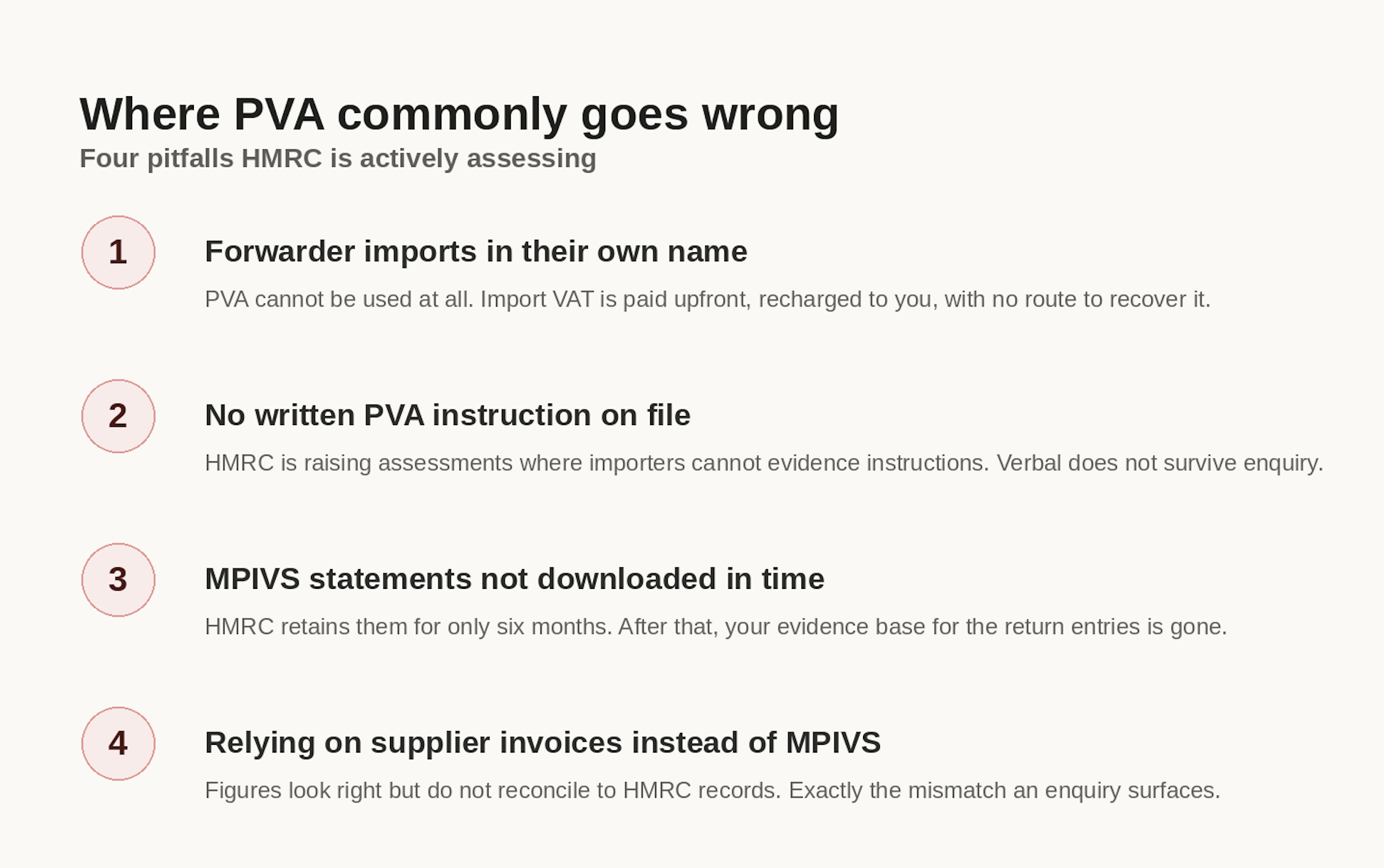
Each declaration made without proper PVA instructions is another assessment waiting to be raised, with the import VAT (and potentially the duty) coming back as a direct demand months or years after the fact.
How to implement it
PVA is available to UK VAT-registered businesses importing goods into Great Britain for business purposes. HMRC’s long-standing position is that only the owner of the goods can use PVA and recover the import VAT as input tax. Whether your customs agent acts as a direct or indirect representative doesn’t disqualify you from PVA if you can prove ownership of the goods. If in doubt, ask your forwarder to walk you through how your details appear on the CDS entry.
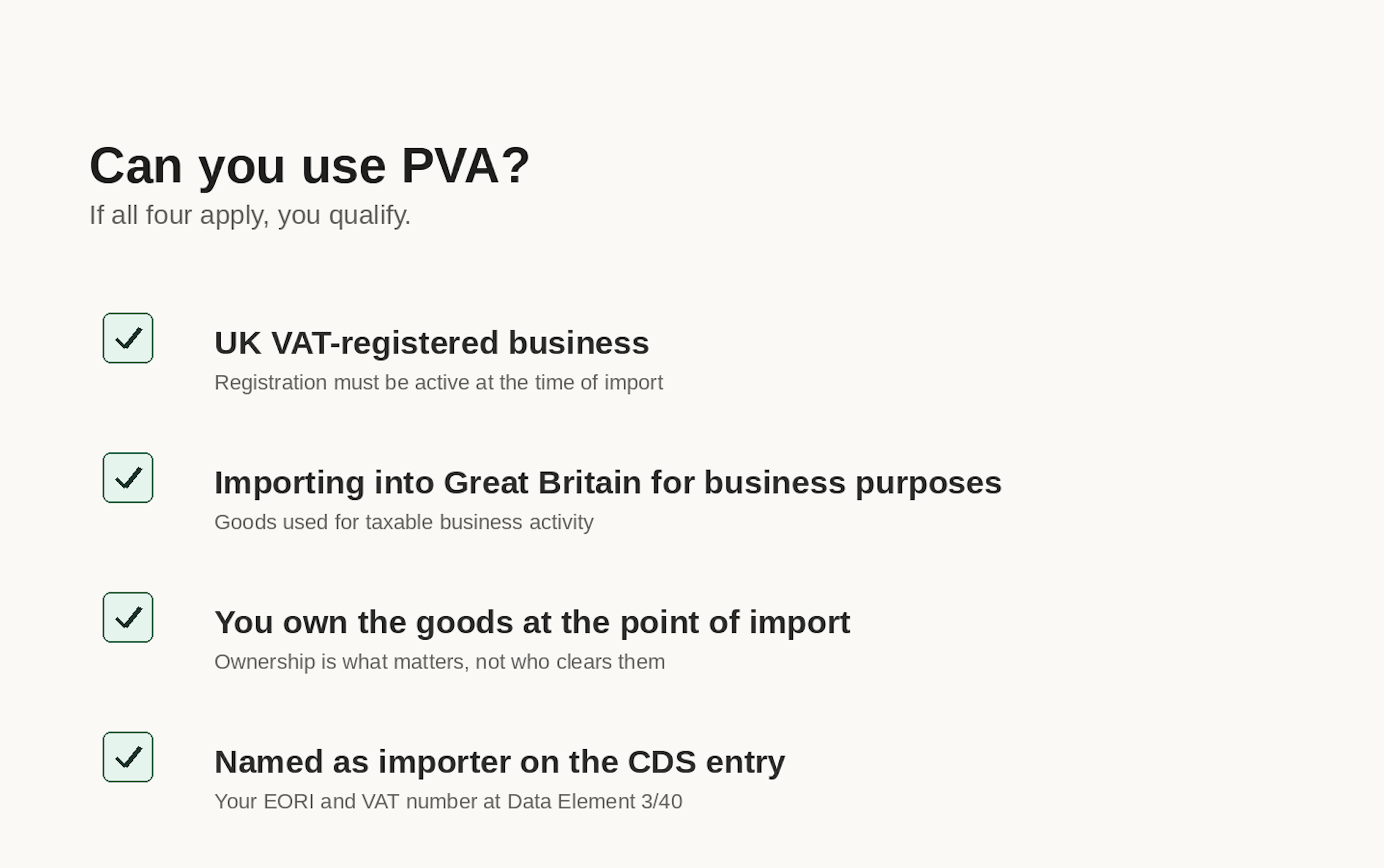
If you are not yet VAT-registered, PVA is not available to you and you will pay import VAT upfront at the border with no straightforward route to recover it. For an early-stage brand importing stock in bulk, that cost is sometimes itself an argument for registering voluntarily before the £90,000 threshold; it is a decision worth modelling carefully.
- Get your registrations and naming right You need a GB EORI number and a subscription to the Customs Declaration Service (CDS), the platform that replaced the legacy CHIEF system. On every declaration, your business must be identified as the importer, with your UK VAT registration number entered at Data Element 3/40 on the CDS declaration. The import VAT is then recorded against your GB EORI number.
- Issue written instructions to your freight forwarders Issue clear, written instructions to every agent handling your imports stating that PVA must be used on all customs declarations and that your business must be named as the importer. A single line in an email is enough, for example: "Please confirm in writing that postponed VAT accounting will be applied on all our import declarations, that [your company] is named as the importer, and that our VAT number is entered at Data Element 3/40. Get written confirmation back and retain that correspondence, this is the audit evidence HMRC will ask for if PVA is challenged.
- Download your MPIVS statements every month Statements typically become available on CDS from around the 10th working day of the following month. Build a monthly process to log in and download each one promptly. This keeps your VAT return entries reconcilable to HMRC’s own records and prevents the retention window catching you out. If a statement is not available before your return is due — most often where declarations are simplified or deferred — HMRC lets you enter a reasonable estimate of the import VAT and correct it once the statement appears, so a late statement need not hold up your filing. The monthly MPIVS download is also the check that the forwarder actually applied PVA: if PVA was used, the import appears on the MPIVS; if it wasn’t, it won’t. If a declaration does slip through without PVA, the import VAT will have been paid at the border, and you recover it on your VAT return using the import VAT certificate (the C79) from your CDS account rather than the MPIVS. The VAT itself is not lost, but you will have taken exactly the upfront cash hit PVA exists to prevent.
The bottom line for your margins
Scaling an e-commerce brand means protecting your working capital. Paying import VAT upfront when PVA is available is an avoidable cost. It effectively turns your business into a short-term interest-free lender to HMRC.
By implementing PVA correctly, instructing your freight forwarders in writing, and building a reliable monthly process for your MPIVS statements, you close the cash gap and keep that capital available for stock, marketing, and payroll.
If you’re unsure whether your current customs setup is structured to use PVA, or whether your freight forwarder is actually applying it on every declaration, get in touch. Given HMRC’s current enforcement focus on written PVA instructions, a short review is worth far more than the time it takes.
This article is intended as general guidance only and does not constitute formal tax advice. Every importing business is set up slightly differently, and what applies to your situation will depend on your specific customs and VAT arrangements — so get in touch before making any changes.
Paying 20% import VAT at the border ties up working capital for months before you can reclaim it, money you’d rather have in stock, marketing and payroll. Postponed VAT Accounting closes that gap entirely: the same shipment clears with nothing leaving your account, the VAT declared and recovered together on one return. The catch is evidence, HMRC is actively disallowing PVA where the importer cannot show a written instruction to the forwarder and the monthly MPIVS statements behind the return, so the setup has to be right before you rely on it.

