the takeaway
Your bank balance only shows cash that has already cleared. For a stock-based brand, cash is tied up for 90 to 120 days, so a profitable quarter can still run dry. A 13-week forecast shows the shortfall coming, with time to act.
An e-commerce founder is preparing for Q4. Today, the bank balance is a healthy £100k. On the strength of that figure, they order £80k of new stock and lift daily ad spend to £1k.
With no forecast in place, they do not see that in Week 5 three outflows will land together: the balance payment owed to the factory, a £15k freight bill, and the monthly advertising charge to their card. Sales are strong, but the corresponding payouts have not yet cleared. In Week 5 the account moves into overdraft; with no agreed facility to absorb it, the factory payment fails. Q4 stock slips by a month, and the founder is forced to pause advertising campaigns that were working, losing momentum at the worst possible point in the year.
The founder was running a seven-figure brand, yet their main way of checking the finances was logging into the bank account each morning to see what had cleared. Your accounting software is built to report what happened yesterday, not what is coming next month.
How many growth decisions are being made on a backward-looking number?
Why the bank feed misleads you
Most founders treat their bank feed as a planning tool, but a bank feed only confirms what has already settled. It does not show the £40k supplier invoice falling due next Tuesday, or the £15k marketplace payout that will not reach you until the following Thursday. The discipline that closes this gap is a 13-week rolling cashflow forecast, the standard tool used by fractional CFOs and turnaround specialists, covering a full financial quarter. It maps the exact week each invoice falls due against the exact week each platform payout is expected to clear.
An effective cashflow forecast is a single weekly grid that contains four things: your opening cash balance for each week; every expected cash inflow timed to the week it actually clears; every outflow timed to the week it actually leaves the account; and your scheduled tax payments, quarterly VAT in particular, which is often the largest single outflow a growing e-commerce business has to plan for. Once those four elements are mapped, a shortfall stops being a surprise. You see it coming, with time to react.

Where forecasts usually go wrong
In practice, it usually goes wrong in one of a few recognisable ways:
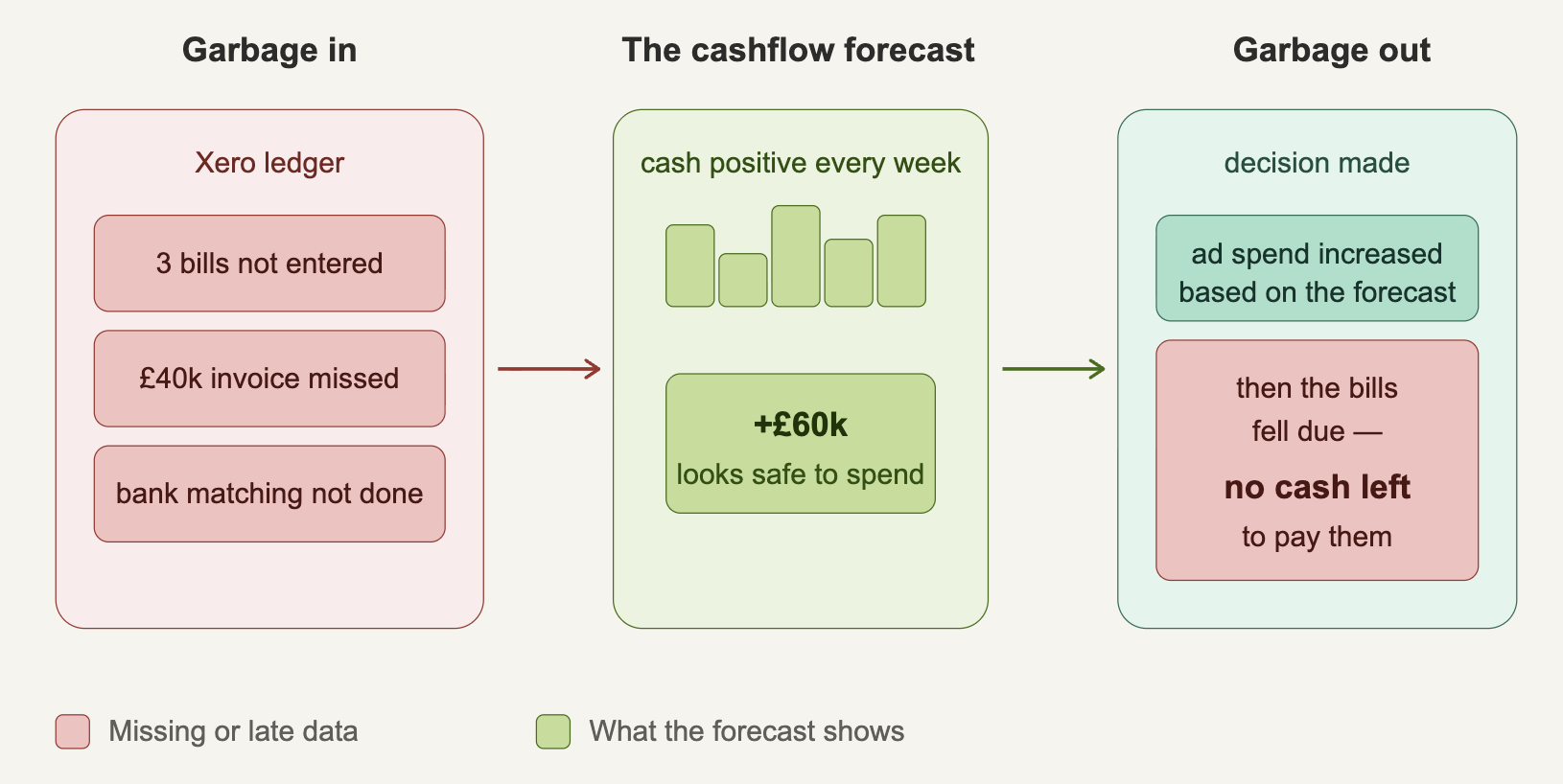
- Letting the bookkeeping lag the forecast. The forecast is only ever as accurate as the bookkeeping feeding it, so if you build the grid from Xero while purchase invoices sit unrecorded, the numbers are wrong before you start. A confident-looking number built on stale data is more dangerous than no forecast at all.
- Managing to the bank balance. Treating today’s cleared balance as spendable cash, when much of it is already committed to invoices that have not yet been drawn.
- Assuming payout timing instead of confirming it. Entering revenue in the week a sale is made rather than the week the processor or marketplace actually settles it, so the forecast shows cash that is not there.
- Forecasting profit, not cash. Profit and cash are on different clocks: a sale counts as profit when you invoice it but as cash only when the money reaches your account. Stock, VAT and loan repayments move cash without moving profit. A quarter can show a healthy margin and still leave the bank empty mid-month.
- Leaving tax out of the timeline. Omitting quarterly VAT and other scheduled liabilities, so the single largest outflow lands as a surprise.
The paradox
“A profitable, fast-growing brand is the one most likely to run out of cash. Growth itself consumes cash.”
Why this hits e-commerce hardest: the cash conversion cycle
There is a reason this discipline matters more for a stock-based e-commerce brand than for almost any other kind of business: the cash conversion cycle. It is the length of time your money is locked up between paying for inventory and finally receiving the cash from selling it. For an e-commerce founder the chain is long. You pay a deposit to the manufacturer, then wait weeks for production. You pay the balance, freight and duty before the goods even land. The stock then sits until it sells through, and only after that does the marketplace or payment processor release the cash — often two to four weeks later still. It is entirely normal for cash to be tied up for ninety to a hundred and twenty days from first deposit to cleared payout.
This is why a profitable, fast-growing brand is the one most likely to run out of cash. Growth itself consumes cash: each reorder is larger than the last, so you are funding a bigger batch of stock before the smaller previous batch has finished paying you back. The faster you grow, the wider that gap opens. A 13-week forecast is the tool that makes the gap visible, but only if the grid captures the parts of the cycle that invoice due dates alone will miss. When you build it, watch for the supplier deposit and the balance payment landing in different weeks; the duty, customs clearance and handling charges that arrive with the freight bill; marketplace reserves that hold back a slice of every payout; refunds and chargebacks that act as negative inflows. Each of these can punch a hole in a grid built only from the dates on your purchase invoices. The gap is widest in the run-up to a seasonal peak, when you are funding the largest stock order of the year months before the sales that pay for it arrive — which is exactly when the forecast earns its keep.
Five steps to a reliable forecast
- Keep the books current as a discipline Process purchase invoices as they arrive and answer your accountant’s queries promptly. The forecast can only see what has actually been entered in your accounting software, so a delay in the bookkeeping is a blind spot in the grid.
- Build the 13-week rolling grid Enter your opening balance, then layer in fixed costs (payroll, software), variable costs (freight, advertising, cost of goods), tax liabilities, and expected payouts. Then roll it forward every week: drop the week that has just closed, add a new Week 13, and check what actually landed against what you forecast. That weekly variance check is what turns the grid into a discipline that sharpens over time.
- Time payouts from your own settlement data Use your actual settlement reports, not assumed dates, to set the real lag and reserve your account is running. Clearance times vary by provider, account age and reserve policy, and they drift without notice as your account matures.
- Test decisions before you make them Stop managing to the bank balance: run every hiring, inventory, and marketing decision of any size against the forecast before committing it. Run scenarios against the grid — “If I increase ad spend by £500 a day, do I dip below my £20k cash reserve in Week 6?”. Set that reserve deliberately rather than leaving it to chance: four to six weeks of fixed costs is a sensible floor, and it is the line the grid must never be allowed to cross.
- Arrange capital early, from strength When the forecast flags a likely shortfall in Week 8, secure a facility or negotiate extended supplier terms in Week 2. The levers worth knowing, roughly cheapest first: extended supplier credit, then a deposit or inventory-finance line, then a revenue-based advance against future marketplace payouts. Lined up while the numbers still look strong, they cost less and come with fewer strings than the same call made in a crisis.
If you do one thing this quarter, build the 13-week grid before your next major spending decision — and let the forecast, not the bank balance, tell you what you can afford.
A 13-week forecast protects your business operations and keeps cash available in the weeks it is needed rather than on average across the quarter. It also lets you keep growing safely. Because each reorder is bigger than the last, growth consumes cash faster than it returns it, and the cash conversion cycle quietly widens as the brand scales. The forecast is the tool that keeps that gap in view, so you can fund the next batch of stock, hold your Q4 ad spend, and treat any pause as a deliberate choice rather than one forced on you by the cycle. It only works on current data, though, so keeping the books up to date is what lets you trust the number.

