The A2X mapping trap that corrupts your Amazon numbers
6 min read
the takeaway
A2X fixes Amazon’s month-end timing, but left on default mapping it carries bad data into your ledger. Bundled cost lines hide your true advertising and fulfilment numbers, and a single VAT code across different sale types can leave your VAT return wrong in either direction. Configuring the software you already have fixes both: audit the mapping, separate the cost lines, and set VAT codes from the actual treatment of each sale.
You installed A2X to fix the Amazon settlement cut-off problem, and it worked — your revenue is finally landing in the right month. So why does your profit and loss account still lump your Amazon advertising spend in with your FBA storage fees? And why do you suspect your VAT figures are not quite right on your international orders?
The uncomfortable possibility is this: the “automation” your accountant set up may be moving bad data into your ledger faster than anyone can catch it. The software is doing exactly what it was told to do. The problem is what it was told.
What the bridge can’t do for you
E-commerce integration softwares (A2X, Link My Books and similar tools) solve one specific problem very well. An Amazon settlement period typically runs for around a fortnight, and a single settlement will frequently straddle a month-end. Posting the gross Amazon payout as one lump on the day it hits the bank therefore misstates revenue across two accounting periods. An integration software apportions that straddling settlement to the correct months and breaks the payout down into its component parts. That part it does reliably.
What it does not do is exercise judgement. An Amazon settlement report contains dozens of distinct transaction descriptions: sales, refunds, promotional rebates, fulfilment fees, storage fees, advertising charges, and more. The software can only post those to wherever it has been told to post them, at whatever tax rate it has been told to apply. If a generalist accountant accepts the default or bulk “auto-mapping” to save set-up time, two things go wrong at once: operationally different costs are lumped into a single account in your ledger and transactions with genuinely different VAT treatments are forced through one tax code.
Since August 2024 most fees to UK-established sellers carry 20% UK VAT, recoverable as input tax; but the treatment is not uniform — advertising and storage on some non-UK marketplaces, and certain FBA fees, still fall under the reverse charge. A bulk 'auto-map' that applies one tax code to everything Amazon deducts will misstate the reverse-charge items in one direction and the standard-rated ones in the other.
Automation without deliberate configuration does not remove the risk of bad bookkeeping.
Faithfully wrong
“The software is doing exactly what it was told to do. The problem is what it was told.”
Where this goes wrong in practice
A business turning over around £2m on Amazon is paying for an A2X subscription. Their previous accountant connected the software to Xero, confirmed that the month-end timing now reconciled, and considered the job done. Because they relied on the bulk auto-map feature, two problems went unnoticed.
Your costs all land in one bucket
“Amazon Sponsored Ads”, “FBA fulfilment fees” and “long-term storage fees” are all flowing into a single Xero account simply called “Amazon Expenses”. When the founder tries to work out their customer acquisition cost, or to understand their true fulfilment margin, the figures they need are bundled together and cannot be separated without going back to the raw Amazon reports.
The VAT treatment is unreliable
The mapping applies a single tax code to broad categories of sales without distinguishing between, for example, a standard-rated sale to a UK consumer and a sale that should be treated differently because the goods were exported, or because Amazon — not the seller — is the deemed supplier for VAT purposes. Where a standard 20% code is applied to sales that should not carry UK output VAT at 20%, the result is that output VAT can be over-declared on the return. The exposure runs the other way too: sales that should carry VAT under the marketplace rules can be missed. Either way, the VAT return no longer reflects the underlying transactions, and that is what tends to draw an HMRC enquiry.
A reconciliation of the VAT return against the settlement data would normally surface a problem of this kind, which is why the mapping should be reviewed by someone who reads the return critically.
How to tell whether this applies to you
- Open the profit and loss account in Xero Then look at how Amazon costs appear. If fulfilment and storage fees sit together in one account, the cost data has been bundled.
- If you sell beyond UK consumers or hold stock in overseas FBA Check how many tax codes your Amazon sales point to. A single code across genuinely different treatments is the warning sign; if every sale you make is a standard-rated UK sale then one code is correct.
- The check that usually earns a specialist their fee Take the Amazon sales for a VAT period, agree them to the Amazon portion of your return, and confirm the output VAT declared matches the treatment those sales should carry. The settlement totals will not simply tie to the return (the return covers every channel, and the settlement periods do not align with the period of the return) which is exactly why this is worth doing meticulously.
A workable approach
The fix is to configure the integration software so that it reflects the business and its actual VAT position:
- Audit the existing mapping Before changing anything, establish where the Amazon transaction types are currently flowing and at what tax rate. The aim is a clear picture of every default mapping, so that decisions are made deliberately rather than inherited from a bulk set-up. The audit also establishes how long any mis-mapping has been running. If the wrong treatment has been applied for several periods, earlier returns may need correcting. Smaller net errors can be adjusted through the next return; larger ones must be reported to HMRC separately. And because a mis-mapping that has run for years is likely to count as careless, simply adjusting it on the next return does not in itself protect against a penalty — an unprompted disclosure to HMRC is treated differently. Knowing the extent of the history is part of knowing what the fix involves.
- Separate the cost lines Break the bundled cost mapping apart so that fulfilment fees, storage fees and advertising spend each post to their own account. This lets the founder see fulfilment cost and marketing cost as distinct figures and calculate metrics such as customer acquisition cost (CAC) and marketing efficiency ratio (MER — total revenue divided by total advertising spend) from the ledger itself.
A note on classification: whether Amazon fulfilment fees are presented within cost of sales or as distribution costs below gross profit is a presentation choice, not a fixed rule. Both are defensible under FRS 102 and FRS 105. The right answer depends on how the business wishes to read its own margins, and should be applied consistently. - Set VAT rates based on the actual VAT treatment This is the part that most rewards proper advice, because the correct VAT treatment of an Amazon sale is not determined by a single factor. It depends on where the goods are physically shipped from, where they are shipped to, the value of the consignment, and whether Amazon is treated as the deemed supplier for the transaction. The following situations all carry different treatments and should never be forced through one tax code:
- Goods exported from Great Britain to outside the UK may qualify for zero-rating — but only where the conditions in VAT Notice 703 are met, including holding valid evidence of export within the required time limit.
- Sales to consumers in the EU are not simply “zero-rated exports”. Depending on the value of the goods and how they are fulfilled, the seller may need to account for the destination country’s VAT, often through the Import One Stop Shop (IOSS) for low-value consignments.
- Marketplace deemed-supplier rules can shift the VAT liability onto Amazon rather than the seller in defined circumstances — for example, certain sales of goods already in UK fulfilment centres, or low-value imported goods. Where that applies, the seller’s supply for VAT purposes is to Amazon, not to the end consumer.
- Stock held in overseas Amazon warehouses (for instance under Pan-European FBA) means the sale departs from that country. It is not a UK export at all and may create a VAT registration obligation in that country.
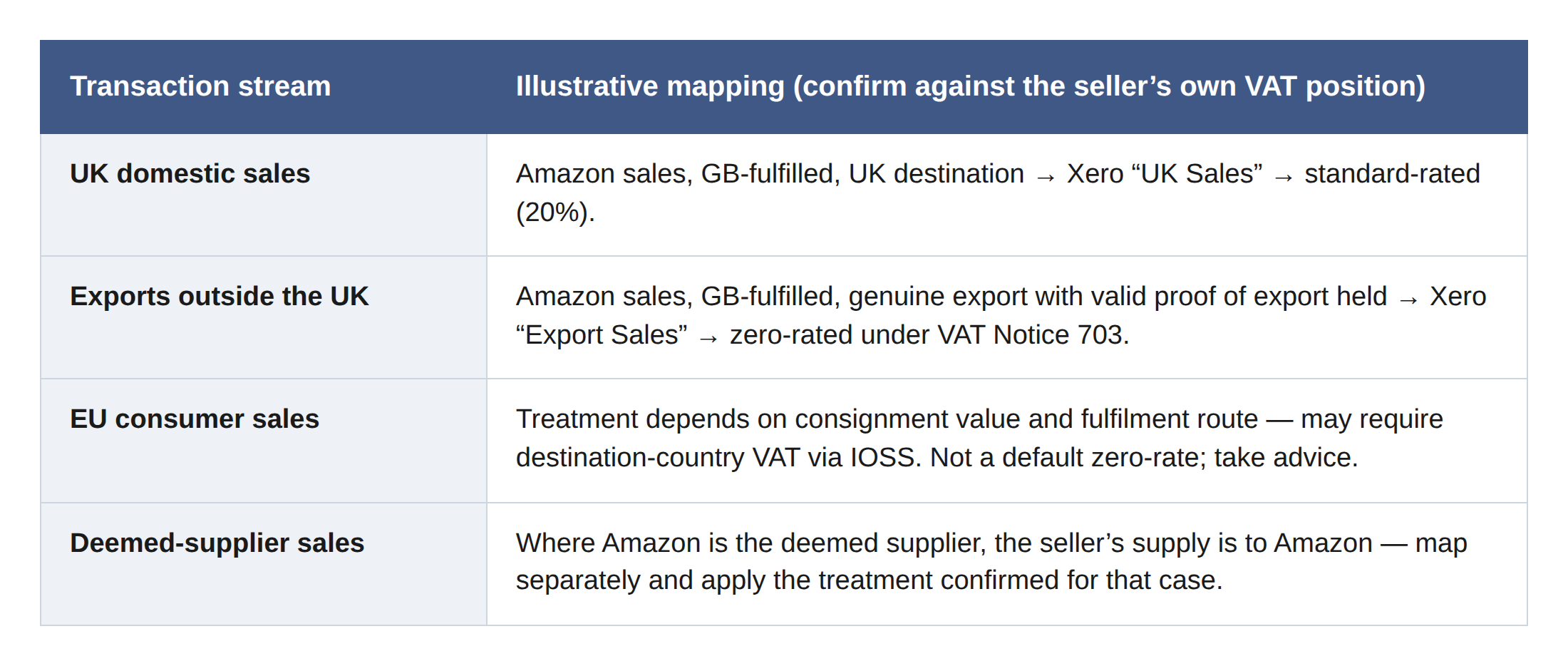
Once the correct treatment for each stream has been established, it can be built into the software’s mapping grid so that the right tax code is applied automatically before the data ever reaches Xero. The grid below is an illustration of how that configuration is structured for one common case — a UK-registered seller fulfilling goods from Great Britain. It is not a statement of VAT law, and the appropriate codes for any given business must be confirmed against that business’s own circumstances.
The diagram below traces the same Amazon data two ways: left on the default auto-map, and configured deliberately stream by stream.

This article is general guidance, not advice for a specific business. VAT in particular depends heavily on how an individual business is set up and where it sells. If you would like your Amazon and A2X set-up reviewed, KKG Accountancy works with e-commerce founders on exactly this.
An integration software solves Amazon’s settlement-timing problem well, but it carries across exactly what it’s configured to carry. Left on a bulk auto-map, that means bundled costs you can’t read and a single VAT code stretched across sales that should be treated differently. Configured deliberately by someone who reads the VAT return critically, the same tool gives you advertising, fulfilment and storage as separate, manageable lines and a VAT treatment that holds up to scrutiny.

