The doorstep charges quietly killing your international sales
8 min read
the takeaway
Ship internationally on the default DAP basis and your customer is ambushed at the door with VAT, duty and a courier handling fee — so they refuse the parcel, and you lose the sale, the return shipping and the customer. The fix is to make delivery feel domestic: IOSS for sub-€150 EU orders, DDP for everything above that and non-EU, with your UK exports correctly zero-rated and the proof of export on file. With the EU’s July 2026 per-item duty, new national parcel fees and the US scrapping its de minimis, every parcel is now a formal import event — and the setup is worth getting right now rather than at volume.
A customer in Germany buys a £200 jacket from your Shopify store. A few days later, they refuse the delivery at their front door because DHL has demanded around €55 in import VAT, customs duty, and handling fees they weren’t expecting. You refund the customer, absorb the lost sale, and pay the return shipping costs.
That isn’t a one-off customer service incident. Without the right tax setup, your packages get held at customs and your international margins are eaten by VAT exposure, courier fees, and refunds — order after order, across every international market you sell into.
Why border charges keep eating your margins
When shipping internationally, many founders default to Delivered at Place (DAP) (historically known as DDU), a term still used loosely in the trade. Under DAP, the customer is responsible for paying any local taxes, duties, and handling fees when the package arrives. That is the mechanic behind the doorstep ambush.
Marketplaces like Amazon do absorb some of this complexity; the EU’s “deemed supplier” rules under Article 14a of the EU VAT Directive can shift VAT collection onto the marketplace in defined scenarios (notably imports of consignments at or below €150, and sales of EU-located stock by non-EU sellers). On your own storefront, none of those shields apply automatically.
What a correct cross-border setup looks like
To scale globally, delivery needs to feel domestic to the consumer, with no surprises at the door. The two operational tools that get you there are the Import One-Stop Shop (IOSS) for low-value EU sales, and Delivered Duty Paid (DDP) for everything else. If your EU volume grows, holding stock inside the EU is a third route with its own VAT regime (local registration and the Union OSS rather than IOSS) and is worth researching on its own.
IOSS — for B2C sales into the EU with a value of €150 or less
Intrinsic value is the goods alone, excluding shipping. You register for IOSS in one EU member state and remit destination-country VAT through a single monthly return. At checkout, your platform charges the correct local VAT rate (e.g. 19% for goods sold into Germany at the standard rate), the IOSS number travels on the customs label, and the parcel clears with no VAT or handling fee at the border.
One important practical point: as a UK-established (non-EU) business, you cannot register for IOSS directly. You must appoint an EU-established intermediary who becomes jointly liable for the VAT, with annual fees typically running £1,500–£5,000. That cost is a real factor in the IOSS-versus-alternatives decision.
DDP — for orders above €150 and for non-EU destinations
Under Delivered Duty Paid, your platform (e.g. Shopify Markets) calculates and collects destination VAT, duties, and any applicable fees at checkout. Your courier is funded upfront, the parcel clears smoothly, and the customer never sees a border bill. DDP is the operational answer for higher-value EU orders, US orders, Australian orders, and the rest of the world. Above €150 you become the importer of record, so it is worth checking whether the import VAT is recoverable or needs a local registration.
UK VAT treatment of the export
Exports of goods from the UK to destinations outside the UK can be zero-rated under VATA 1994 s.30(6), but zero-rating is conditional. You must (a) physically export the goods, (b) hold valid official or commercial evidence of export, and (c) obtain that evidence within three months of the time of supply (VAT Notice 703, which has the force of law in part).

Where it commonly goes wrong
The DAP default
The single most common error. Let’s look at the financial impact of selling that £200 jacket to a customer in Berlin under DAP. Your customer pays £200 at checkout. When the parcel reaches the German border, customs assess German VAT at 19% on the customs value, plus customs duty (since the consignment is above the €150 threshold), plus a courier handling fee in the order of €15. The customer receives a request for around €55 before delivery. They feel ambushed, refuse the parcel, and the jacket is shipped back to your UK warehouse. You’ve lost the £200 sale, burned roughly £15 on return shipping, and lost the customer.
Wrong VAT mapping in Xero
Shopify-to-Xero integrations frequently default international sales to 20% UK VAT rather than routing them to a zero-rated income account, a common error that slowly costs founders five figures.
Missing proof of export
Without that evidence, HMRC will treat the supply as standard-rated and assess you for the VAT (see H Ripley & Co TC09067), where over £1.1m of zero-rating was denied for inadequate proof.
EU volume without an IOSS intermediary
If you ship a material volume of sub-€150 B2C orders into the EU but haven’t appointed an intermediary, every parcel clears under DAP, with the doorstep ambush and refund pattern repeating order after order.
Left untouched, these compound: VAT under-declared and at risk of HMRC assessment, refund and return rates climbing on EU orders (with the VAT and duty already paid on those returns rarely reclaimed), international conversion rates falling as word of the doorstep charges spreads in reviews, and the underlying landed cost of every parcel rising as new EU and member-state fees come into force.
The new EU low-value parcel rules (live from 1 July 2026)
As of 1 July 2026, the EU has introduced a transitional flat-rate customs duty of €3 per item type by tariff classification on consignments valued at €150 or less, where the seller is registered for IOSS. This is an interim measure that runs until the EU Customs Data Hub goes live (currently targeted for around 2028), at which point standard tariff rates will apply to all low-value imports.
Two points to be precise about, because the press coverage has been loose:
First, the €3 is separate from VAT
It is not collected through your IOSS return. How exactly it is collected at the border (by the carrier, by a deemed importer, or by other means) is still being operationalised through implementing regulations as of mid-2026. Your platform and carrier will need to handle this; you should not assume your existing IOSS workflow does it automatically.
Second, it is charged per tariff line
The €3 is charged per distinct item type by tariff classification, not per parcel and not per unit. A parcel containing three identical dresses (one classification) attracts a single €3 charge. A parcel containing a dress, sunglasses, and a handbag (three distinct classifications) attracts €9. Get your HS classifications right or this will bite.

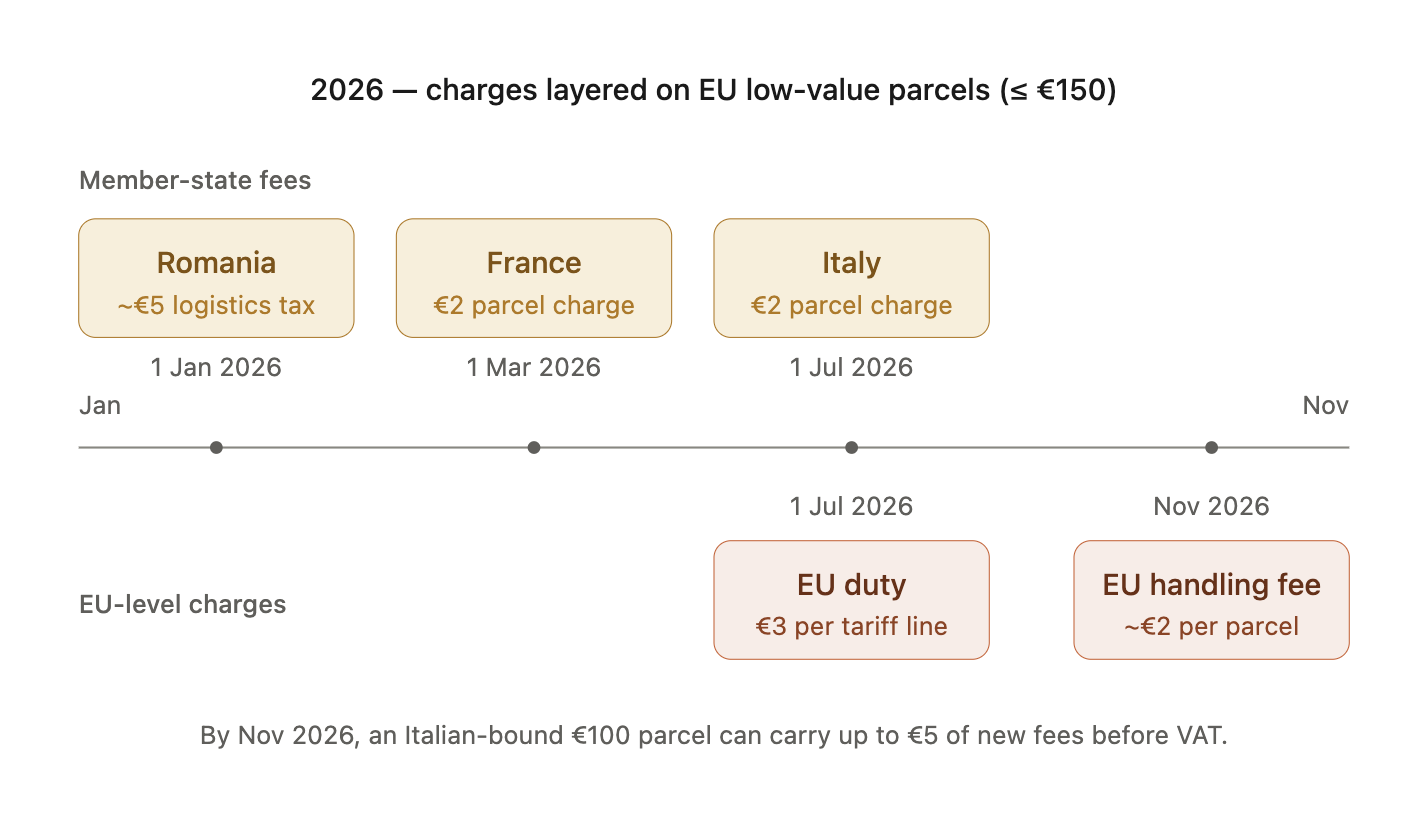
The direction of travel is not confined to the EU. At Autumn Budget 2025 the Chancellor announced that the UK's own £135 customs duty relief will be removed by March 2029 at the latest. That reform lands on the stock you bring in rather than the orders you send out, but the principle holds on both sides of the border.
Frictionless delivery
“To scale globally, delivery needs to feel domestic to the consumer — no surprises at the door.”
What to put in place now
- Audit your Shopify-to-Xero VAT mapping and proof-of-export process Ensure international sales route to a zero-rated income account rather than defaulting to 20% UK VAT, and ensure your fulfilment process actually generates and retains valid proof of export (CDS departure messages, airway bills, CMRs) for every international order — without both, HMRC can reassess the supply as standard-rated and the zero-rating will be denied for missing evidence within the three-month window. Concretely, in the Shopify connector settings for Xero or QuickBooks, check where the default tax rate for international orders is set: it should map to a “Zero Rated Income” (or “Zero Rated EC/Export”) account, not “20% (VAT on Income)”. If you are unsure how the mapping is configured, this is a five-minute check worth handing to your bookkeeper before your next VAT return.
- Decide on IOSS now that the July 2026 rules are live If you ship a material volume of sub-€150 B2C orders into the EU, IOSS remains the best route to clean, predictable customs clearance, even with the new €3 duty and national fees layered on top. Budget for the intermediary cost and treat it as the price of border friction insurance. As a rough decision rule: once you are shipping a few hundred sub-€150 EU orders a month, the intermediary fee spreads thinly enough that the case for registering is clear; below roughly 50 orders a month it rarely is. If your EU volume is low or your average order value sits above €150, IOSS may not be worth the overhead.
- Activate DDP for higher-value EU orders and non-EU markets For orders above €150, for the US, Australia, and other non-EU destinations, use Shopify Markets (or equivalent) to calculate and collect duties and destination taxes at checkout. (This, and exporting generally, needs a GB EORI number in place.) This avoids the doorstep surprise and keeps your refund rate down. Note that the US ended its $800 de minimis exemption for all countries in August 2025, with permanent removal now legislated from July 2027, so DDP-style upfront collection now matters for low-value US orders too.
- Get your product commodity (HS) codes right Under the new EU rules the €3 duty is charged per distinct tariff classification in a parcel, so the number of commodity codes you ship directly drives your landed cost. The US removal of de minimis pushes the same way: every parcel now needs a correct 10-digit tariff code filed electronically, and the code determines the duty rate applied. Misclassification cuts both ways — it can mean overpaying duty on every order, or under-declaring and carrying a customs liability if HMRC or an EU customs authority reviews it. Practical step: build a master list mapping every SKU in your catalogue to its correct commodity code, confirm it with your courier or a customs adviser, and load those codes into your store and shipping software so they travel on every customs label automatically. For a catalogue of any size this is worth doing once, properly, rather than leaving each parcel to a warehouse best-guess.
The bottom line
Cross-border tax is no longer a problem you can defer until volume justifies it. The EU’s 2026 changes, the UK’s planned removal of its own £135 customs duty relief by March 2029, and the US ending its $800 de minimis all point the same way: every parcel becomes a formal import event, with duty, tax, and data requirements attached.
If you’re selling internationally on your own storefront, three things need to be true: your UK VAT mapping correctly zero-rates exports (with evidence retained), your IOSS arrangements are in place if your EU volume justifies them, and your higher-value international orders are shipped DDP. If you’re not sure any of those are true today, get in touch; it’s worth a short review well before the next round of changes lands.
Before your next batch of overseas orders ships, confirm where the customer actually pays — at checkout, or at their own front door. On the default basis it’s the door, and that’s precisely where the sale gets lost.
This article is intended as general guidance only and does not constitute formal tax advice. Cross-border VAT and customs rules are evolving rapidly through 2026 — what applies to your business will depend on your specific sales channels, fulfilment model, and order profile. Please get in touch before making structural changes.
Route by order value and destination. Sub-€150 B2C orders into the EU belong in IOSS once you are shipping a few hundred a month; below roughly 50 the intermediary fee rarely pays for itself. Everything above €150, and everything outside the EU, ships DDP with a GB EORI in place. Your UK exports are zero-rated only if the proof of export is on file within three months, and only if your accounting system routes those sales to a zero-rated income account rather than 20% UK VAT. Get your HS classifications right, because the EU's €3 duty is charged on each one.

