The margin you’re pricing against may already be gone
5 min read
the takeaway
The gross margin in your monthly accounts is often based on the unit costs you loaded at launch — now months out of date, as supplier prices, freight and duty have all moved. Those stale margin figures overstate profit and fund pricing and ad-spend decisions out of outdated information. Refresh landed costs monthly and reconcile by unit . You can check the gap yourself on your top products today.
Your accountant tells you your product margin is 60% based on last year’s costs. But raw material prices, factory rates and freight have all moved since then.
Is that headline margin still protecting your cash position, or is it quietly masking a gradual erosion that your management accounts are not picking up?
Why a stale gross margin % becomes a scaling trap
In our experience, monthly management reporting for e-commerce SMEs is often produced on a “set and forget” basis: a unit cost is loaded into Shopify or the bookkeeping system at launch, and the same figure is used to calculate cost of sales month after month, even when supplier invoices tell a different story. This is not a question of whether the year-end statutory accounts are compliant; properly valued closing stock will usually correct the position on the balance sheet at year-end.
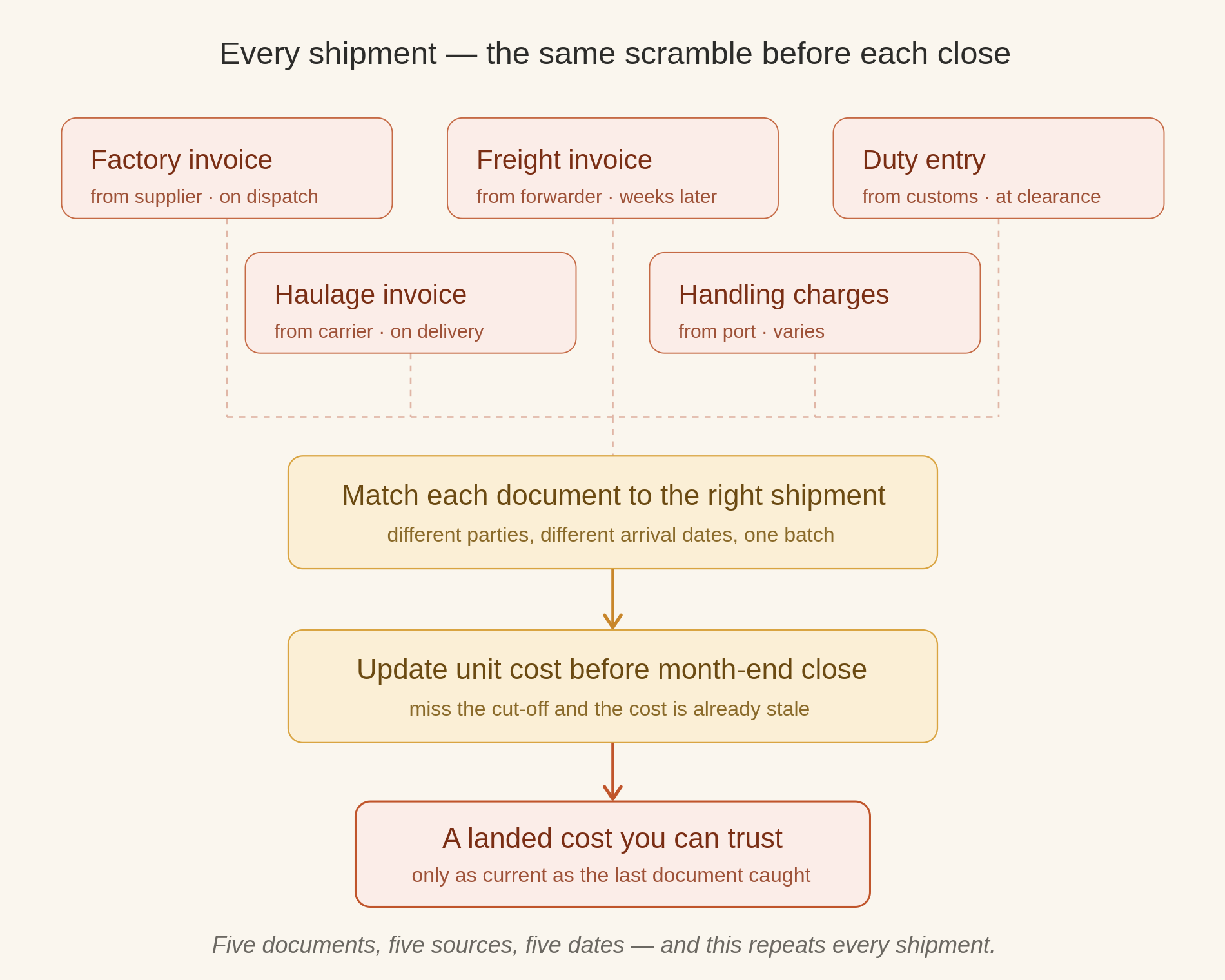
The issue is that, for the eleven months in between, the founder is making pricing, ad-spend and cash-flow decisions on figures that no longer reflect what the next container actually costs to land. If unit costs are not being refreshed against the latest purchase invoices, freight charges, duty entries and (where applicable) postponed VAT statements, the gross margin shown each month is an opening assumption, not a current measurement.
What the law says
The cost of inventories is recognised in the profit and loss account in the period in which the related revenue is recognised. FRS 102 paragraph 13.4 requires inventories to be measured at the lower of cost and estimated selling price less costs to complete and sell, with “cost” defined as including costs of purchase, conversion, and other costs incurred in bringing inventories to their present location and condition (the fully landed unit cost). The permitted stock valuation method is FIFO or weighted average cost (LIFO is prohibited). Under FIFO a cost rise does not reach your cost of sales until the older, cheaper stock has sold through, so a stale figure can lag reality for longer, whereas weighted average blends a new cost in sooner.
The practical question for management reporting is whether the unit cost inputs feeding your monthly profit and loss figures are being kept current, because a sustained understatement of cost of sales overstates profit, brings forward a higher corporation tax charge and distorts every decision made off the back of those numbers.
Where this goes wrong in practice
A founder launches a hero product on a 30% cost of sales assumption, giving a 70% gross margin. Over the following two quarters, the factory raises its unit price by £2.00 because of raw material shortages, and ocean freight rates move materially. The bookkeeper continues to post cost of sales at the original 30%, because the unit cost loaded at launch has never been updated. Management accounts show the product comfortably profitable, and the founder authorises a £20,000 increase in paid social spend. It is not until the year-end stocktake and accounts preparation — when the latest landed cost is finally reconciled against units sold — that the real picture emerges: the actual cost of sales had risen well above 30%, and the additional ad spend had been funded out of margin that no longer existed. The campaigns hit their volume targets; the contribution was close to break-even.

Before you scale
“Scaling decisions depend on the gross margin figure being a current measurement, not a twelve-month-old average.”
What better monthly reporting looks like
The effective monthly reporting methodology involves a closing routine that keeps the unit cost feeding your management accounts timely and in line with what the business is actually paying. In practice, that comes down to four controls running every month:
- Refresh the unit cost master Every new purchase order and supporting freight, duty and import VAT document is reviewed on arrival, and the landed unit cost in the bookkeeping system is updated for that batch before the next month-end close.
- Reconcile units, not just totals Sales unit data from Shopify is reconciled against the relevant landed cost rather than against a static percentage applied to revenue.
- Build the cost change into pricing decisions When a new shipment lands at a materially different unit cost, the gross margin position is reported to the founder before the next ad-spend or pricing decision is made, not at year-end.
- Write down stock that is now worth less than it cost The same review that catches a rising cost should catch the opposite case: slow-moving, seasonal or end-of-line stock whose realisable value has dropped below what you paid for it. FRS 102 requires inventory to be held at the lower of cost and its estimated selling price less costs to complete and sell, so carrying dead stock at full cost overstates both your closing stock and your profit.
-
How to check whether this is happening to you
You can run it yourself, on your three highest-volume products, without waiting for a single management account:
- Find the cost the system is using, and the date it last changed Open the unit cost held against each product in Shopify or your bookkeeping system. If that figure has not been updated since before your last two or three shipments landed, your margins are outdated.
- Work out your true landed cost from the most recent shipment Take the supplier invoice, the freight invoice and the customs duty for that batch, then add the other costs of getting it to your door: clearance and broker fees, freight insurance, and inbound transport from the port to your warehouse or 3PL. Convert any foreign-currency invoice at the exchange rate on the date of purchase, so any movement in the rate is already in the number, and leave out any import VAT you can reclaim, since that is not part of unit cost. If the shipment carried more than one product, the freight covers all of them, so split it across the SKUs — cubic volume is usually the fairest basis. Duty is best taken line by line from the customs entry, since rates differ by product, and only split by value if you have nothing but a lump sum. Add it all up, divide by the number of units in the batch, and that is what the product actually costs to land today
- Size the gap, and multiply it out Take the difference between the true landed cost and the cost the system is using, and multiply it by the units of that product sold so far this year. If the true cost is higher, that figure is roughly the profit your management accounts have overstated — and an indication of the corporation tax you may have brought forward and the margin you may have over-committed to ad spend. If the true cost is lower, the gap is running the other way: you may be pricing too cautiously and leaving margin on the table.
The bottom line
Scaling decisions depend on the gross margin figure being a current measurement rather than a twelve-month-old average. The first step is simply checking whether your current numbers are telling you the truth; from there, it is about holding that accuracy in place month after month. The accounting standards already define the methods you need — FIFO and weighted average are both fully compliant under FRS 102 — but the value comes from running them with monthly discipline and feeding the result into commercial decisions while they still matter. That’s where the management-accounting work earns its keep.
If you’d like to discuss how this would apply to your stock and reporting cycle, please get in touch.
A gross margin built on launch-day costs stops being a measurement once supplier prices, freight and duty move — and every pricing, ad-spend and cash decision taken on it inherits the error. Keep the landed unit cost current month to month, reconcile sales by unit against it, and report a material cost change before the next decision rather than at year-end. The standards already give you the method; the value is in running it with monthly discipline, while the numbers can still affect your decisions.

