the takeaway
The balance sitting in your Stripe or PayPal clearing account may not be cash at all. It’s an unanalysed figure, and if it only ever grows it’s collecting errors. Left unreconciled, it can misstate your profit, corporation tax and VAT, in either direction. You can spot the warning signs without being an accountant, and cleaning it up is work worth scoping with a specialist.
Your Xero balance sheet shows £10,000 sitting in a Stripe clearing account. Your Stripe dashboard shows a balance of zero. When you ask, your bookkeeper says that it will wash out eventually.
It probably won’t. More importantly, that £10,000 is not necessarily money. It is an unanalysed figure, and until somebody breaks it apart you do not know whether you are looking at a timing difference, an unrecorded fee, an FX movement, a missing chargeback, or, in the worst case, three years of accumulated bookkeeping errors that have quietly distorted your profits — in either direction.
Why payout-based bookkeeping goes wrong
Whether you sell through your own Shopify store, a marketplace like Amazon, or take payment directly through a gateway like Stripe or PayPal, the money that lands in your bank is never the money your customer paid. It arrives net — net of processing fees, refunds, chargebacks, any rolling reserve, and on overseas sales, FX conversion..
Tools like A2X or Link My Books are designed to handle these deductions adequately so long as the account mapping is set up correctly. They post the gross sale, then post the fees, refunds and adjustments separately, with the difference parked in a clearing account on the balance sheet. When the actual payout hits the bank, it clears that specific batch back to nil.
Done properly, this gives you:
- Turnover recorded gross
- Fees recorded as expenses (visible, deductible, and measurable as a percentage of revenue)
- Refunds and chargebacks properly tracked
- A clearing account that nets to nil for any fully settled payout cycle
Done improperly, and this is where many generalist bookkeepers fall down, the bookkeeper doesn’t know how to handle the edge cases where the bank deposit doesn’t perfectly match a single clearing journal.
They typically stumble over three common scenarios:
Month-end splits
E-commerce payouts often cross over month-end. A2X correctly splits a single payout cycle into two separate journals to ensure revenue is recognised in the right month. The bookkeeper sees one lump sum in the bank feed but must match it against two clearing journals.
Hidden FX and bank charges
When selling internationally, the actual cash landing in the local bank account is often slightly less than the platform’s expected payout due to the exchange margin built into the conversion rate and the intermediary bank charges deducted while the money is in transit.
Third-party payment gateways
Shopify Payments settles natively, so payouts and their fee breakdown reconcile cleanly against the clearing account from a single data source. Third-party gateways like Stripe, PayPal or Klarna settle on their own schedules and deduct their fees within their own systems, so each clearing account has to be reconciled separately against the gateway's settlement reports.
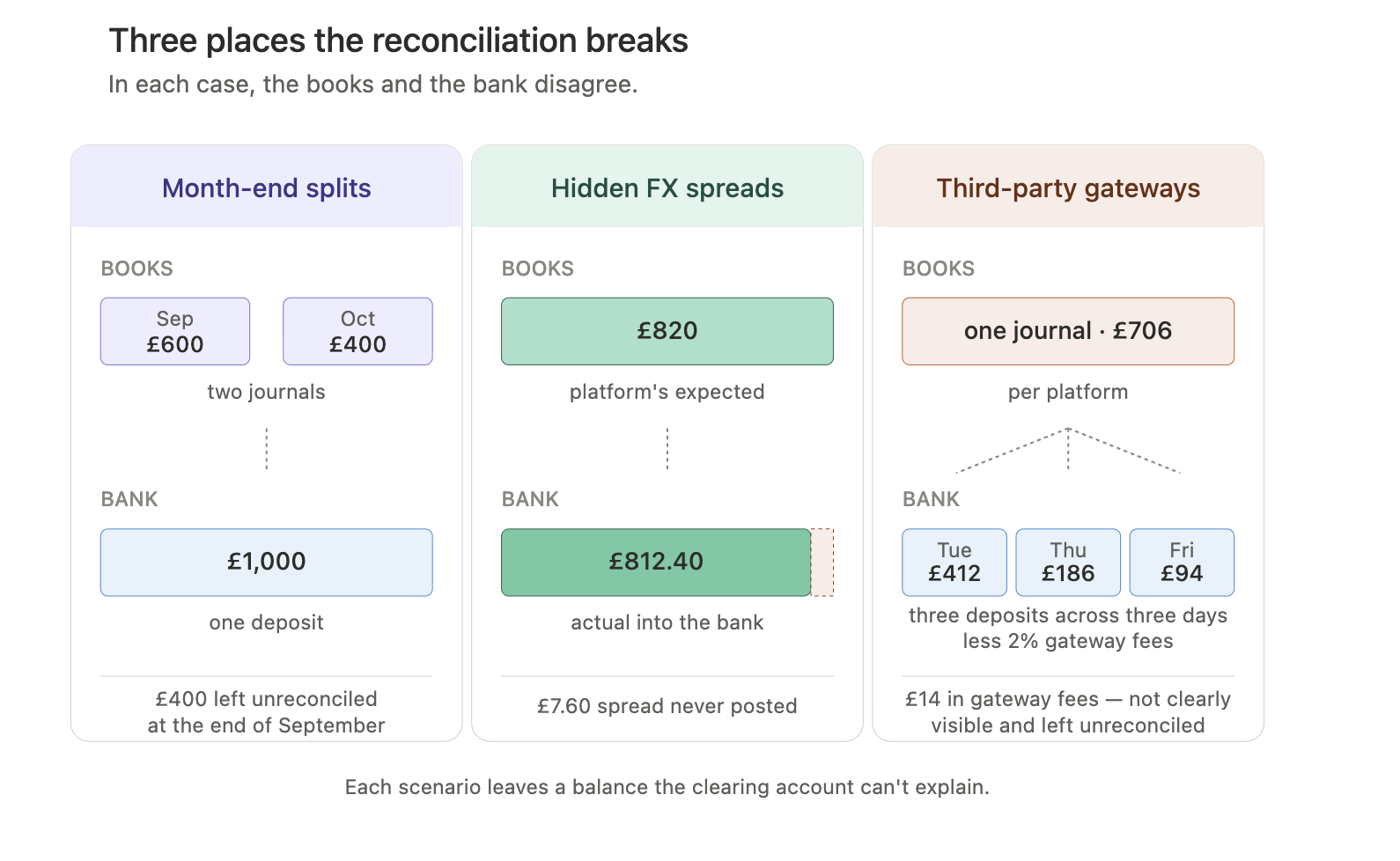
Faced with these discrepancies, an inexperienced bookkeeper will often just look at the bank feed, match the payout against whatever is closest in the clearing account, and move on. The small leftovers (FX differences, split-period balances, or unaccounted gateway fees) are left behind. Over time, they accumulate.

The blind spot
“Until the balance on your clearing accounts is analysed, you do not know which way it points; you only know the figure on your tax return was built on a number nobody could explain.”
How to tell if you have this problem — without being an accountant
You do not need to understand journals to spot a clearing account that is drifting. Open your balance sheet in Xero (or ask your bookkeeper to put the clearing account in front of you) and look for any of the following:
- The balance only ever grows. Your clearing-account balance should grow with sales, never faster. Compare it against monthly sales across the last year. If it's outpacing them, cash is getting stuck that should have cleared.
- It is bigger than a few weeks of payouts. As a rough sanity check, a clearing account should rarely hold much more than the value of payouts genuinely in transit — broadly a week or two of sales, plus any contracted reserve. If the balance is several months of takings, something other than timing is sitting in there.
- Nobody can break it down on request. This is the single most telling test. Ask whoever does your books one question: “Can you show me a list of exactly what makes up the balance in this account today?” A properly maintained account produces a short, evidenced list — these payouts in transit, this reserve, this FX variance. “It washes out eventually” is not an answer; it is the symptom this article is about.
If none of these apply, your clearing accounts are probably fine. If one or more do, the next two sections cover what good practice looks like and what fixing an existing mess actually involves.
A workable approach to clearing-account reconciliation
For an e-commerce business of any meaningful scale, the practical steps are:
- Reconcile by payout, not by month. Each completed payout should clear its own batch in the clearing account to nil. The residual balance at any point in time should then represent only payouts in flight, uncleared third-party gateway funds, and any FX variances — each of which you can list and evidence.
- Pull the gateway’s settlement reports, not the dashboard summary. The summary view nets everything together: fees, refunds, reserves and timing collapsed into a single payout figure you can't take apart. You need the settlement-level export, where those line items show up individually: Stripe's Balance Transactions, PayPal's transaction history, the settlement files from Amazon and Shopify Payments.
- Reconcile gross-to-net at the platform level. Total sales reported by the platform should match total gross sales in your books. Total fees should match. Total refunds should match. If they don’t, the reconciliation is not complete.
- Treat any leftover balance as a finding to be investigated. Anything that cannot be tied to a specific timing item or reserve should be followed up, journalled to the correct account, and documented.
What cleaning up an old balance actually involves
The steps above keep a clean account clean. But if you have read this far and recognised these issues within your own books, don't panic. But don't put it off either. Depending on how many channels and years are involved, this can be a substantial piece of work. A specialist works back through the settlement periods and clears it. And it only gets bigger the longer it's left, so the job is most manageable the sooner it's faced
It can be fixed retrospectively
You do not have to unpick every transaction since you started trading. The usual approach is to reconcile recent periods properly so the account is correct going forward, then analyse the remaining historic balance as a single block to work out what it is actually made up of.
The correction may, or may not, touch prior-year accounts
If the error is small relative to your profit, it is often adjusted in the current year. If it is material (large enough to change the picture for a reader of your accounts) the prior-year figures may need to be restated and earlier tax returns amended. Which path applies is a judgement call, and it is one of the main reasons this is worth getting a specialist to scope before you start.
The correction can move profit in either direction
This is the part founders most often get wrong. It is tempting to assume a stale clearing balance has understated your profit, but the unwind goes both ways. If the residue is processing fees and chargebacks that were deducted from your sales but never recognised as costs, your profit was overstated and you very likely paid more corporation tax than you owed. If instead the residue is a gateway deposit sitting in the account with no sale behind it (orders that were never brought into your sales ledger) your profit was understated.
VAT can be affected too.
If gross sales were recorded incorrectly, the output VAT on past returns may have been wrong as well — so a clearing-account clean-up can surface a VAT correction alongside the corporation tax one. Both corrections have their own rules and time limits for amendment or disclosure, which is why this is better dealt with deliberately than discovered in a hurry at year-end.
If you are running an e-commerce business and your clearing accounts have not been reconciled line-by-line in recent memory, that’s the kind of thing we look at.
An unexplained clearing balance usually marks the visible end of a bookkeeping pattern that can distort profit, corporation tax and VAT together. Reconcile by payout from the gateway’s settlement reports, and treat anything left over as a finding to investigate and document. The fix is mostly discipline and the right reports, and the cost of leaving it grows with every cycle.

