Why your dollar sales shrink before they reach your bank
7 min read
the takeaway
Your dollar sales lose more margin than the gateway fee suggests. A round-trip conversion costs a £500k brand around £8,000 a year, and a year-end retranslation step non-specialists skip can leave your corporation tax bill wrong in either direction. Fix both with a native-currency account and multi-currency accounting — then ask the question underneath: which currency is your business really in?
Many UK e-commerce founders find themselves in this position: US sales are growing nicely, but when the payouts arrive in the UK bank account, the margin looks tighter than the management accounts suggested. The assumption is that a 2% payment gateway conversion fee is the only cost. But when that same money has to be converted back into USD to pay a Chinese factory, and when the bookkeeping isn’t set up to handle multi-currency properly, the real cashflow impact is meaningfully higher. Your corporation tax bill is also affected.
This is a working capital problem and a bookkeeping problem rolled together, and most founders only notice it when they look closely at year-end. As a rough test of whether it applies to you: if more than a quarter of your sales (or costs) sits in a currency other than the one your accounts are filed in, it almost certainly does.
Why default treasury setups erode working capital
The double conversion cost
Take an illustrative £500,000 revenue brand selling primarily into the US but reporting in GBP. Assume the founder allows their payment gateway to auto-convert roughly $350,000 of US sales into GBP, with a spread of around 2%. Some weeks later they owe their supplier roughly $150,000 and wire GBP via a high-street bank to settle it, at a spread closer to 2.5%. Those round-trip costs the business in the region of £8,000–£8,500 in friction before any other FX movement. That is roughly £5,500 lost on the inbound leg (2% of $350,000) and roughly £3,000 on the outbound leg (2.5% of $150,000).

The year-end retranslation step
Non-specialist accountants frequently miss this step at year-end. Under FRS 102 paragraph 30.9, foreign currency monetary items — trade debtors, trade creditors, foreign cash balances — must be retranslated to GBP at the closing rate on the balance sheet date. If the bookkeeping has been done on a GBP-only basis (the foreign currency transactions converted to GBP at the date they were posted, with no separate native-currency ledger maintained), this retranslation step often gets skipped entirely. The foreign currency balances sit on the books at historical rates, the resulting exchange gain or loss never appears in the P&L, and the year-end accounts misstate the financial position.
The corporation tax consequence
Under CTA 2009 Parts 5 and 6, exchange gains and losses on monetary items are brought into the corporation tax computation as they accrue. If retranslation has been skipped, the FX gain or loss never reaches the accounts, and so never reaches the CT600 tax computation. The result is either an under-declared profit (a tax exposure waiting for HMRC to find on enquiry) or an over-declared profit and a real corporation tax payment on profit the business never actually made. Either way, there is a cash impact.

The question underneath
“Underneath all of it sits the functional currency question — the one most worth raising with your accountant first, because it sets the framework the other two fixes operate within.”
The question to ask before any of this: which currency are you really in?
There is a more fundamental question that many UK e-commerce companies rarely consider. The worked example above assumed the business reports in GBP. That is the natural assumption for a UK-incorporated company with a GBP bank account and a GBP filing obligation with Companies House — but it is an assumption, not a given, and for a brand whose sales are overwhelmingly in USD it may be the wrong one.
Functional currency vs presentation currency
FRS 102 distinguishes between two currencies. The functional currency is the currency of the primary economic environment in which the business actually operates — broadly, the currency that mainly determines its sales prices and its costs. The presentation currency is simply the currency the accounts are presented in, which for a UK company filing with Companies House will normally be GBP. The two do not have to be the same. A UK-incorporated brand that prices and sells mainly in USD, and pays its manufacturer in USD, may well have a USD functional currency even though it is a British company filing GBP accounts.
Where the FX volatility lands
This matters in practice, because the functional currency determines where FX volatility lands. If GBP is treated as the functional currency, USD debtors, USD creditors and USD cash are all foreign currency monetary items, and every closing-rate retranslation of them runs through the profit and loss account — which is exactly the FX noise, and the corporation tax consequence, described in the previous section. If USD is the genuine functional currency, those same balances are no longer foreign items at all, so most of that P&L volatility simply disappears. What remains is the translation of the finished USD result into a GBP presentation currency, and that translation difference is taken to reserves through other comprehensive income rather than to the P&L — a quieter outcome with a different, and often more benign, tax profile.
It reaches the tax computation too
It also reaches the corporation tax computation itself. There are specific rules governing the currency in which a company’s tax computation is prepared where its functional currency is not sterling, and getting the functional currency wrong means the computation is being built on the wrong base — even where the accountant is diligently performing the year-end retranslation described above. In other words, the retranslation step is the right thing to check, but it is being done inside whatever currency framework the business has defaulted into, and if that framework is wrong the diligence is being applied to the wrong set up.
The practical check
The practical check mirrors the one in the next section. Ask your accountant whether anyone has actually assessed your functional currency under FRS 102, by reference to the currencies that drive your sales prices and your costs, rather than assuming it is sterling because the company is UK-registered. For many founders the answer will still be GBP but it should be a conclusion the business has actively reached and documented. Functional currency is also not necessarily fixed for life: as a brand’s sales and cost base shift, the right answer can change, so it is worth revisiting as the business scales.

Building a more efficient treasury structure
Each of the two issues above has a practical fix, and neither requires complex hedging or exotic banking arrangements. The work sits in changing the default banking and bookkeeping setup.
- A native-currency collection account On the double conversion cost, the fix is a native-currency collection account. Multi-currency accounts (offered by providers such as Wise, Airwallex and Revolut Business, and increasingly by the high-street banks themselves) allow USD revenue to be held in USD rather than auto-converted by the payment gateway. That USD balance can then be used to pay USD-denominated suppliers directly. The first leg of the round-trip conversion is removed, the second leg is removed, and residual FX exposure is limited to the timing and amount mismatch between USD revenue and USD supplier payments, which is materially smaller than the full round-trip volume. It does not, though, remove the conversion you still face on the GBP side of the business: corporation tax is paid to HMRC in sterling, and so are most UK salaries, dividends and domestic overheads — so a UK company will always need to convert some of its USD surplus back into GBP. The gain is that you convert deliberately, in larger and better-priced batches at a time of your choosing, rather than letting the gateway do it automatically on every payout. That residual exposure is itself reduced further by timing USD inflows and USD outflows to fall close together — scheduling supplier payments to draw down the USD balance while it is still fresh, rather than letting it sit and drift, is a simple form of natural hedging that needs no banking product at all.
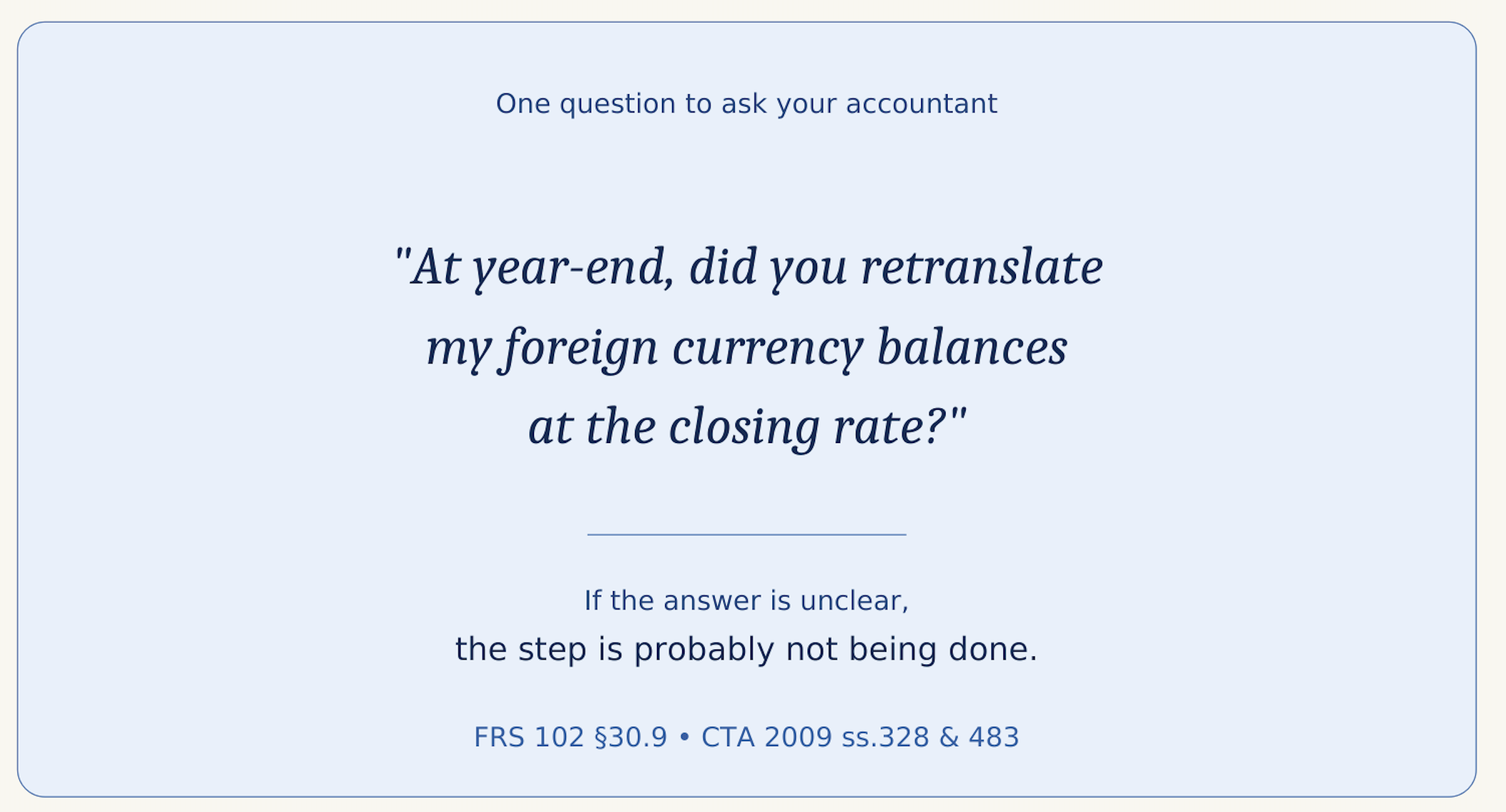
- Multi-currency accounting and a year-end check On the year-end retranslation step, the fix has two parts. First, use cloud accounting software set up for multi-currency from the outset. Xero and QuickBooks Online both maintain foreign currency balances natively, and both run an automated period-end retranslation at the closing rate with the resulting exchange difference posted to a dedicated FX gain or loss account. Second, and more importantly, work with an accountant who knows to look for it. If your current accountant is not a multi-currency specialist, the practical check is straightforward: ask whether your year-end accounts include a closing-rate retranslation of foreign currency monetary items under FRS 102 paragraph 30.9, and whether the resulting gains or losses have been brought into the corporation tax computation, where they’re usually taxable or deductible as they arise. If the answer is unclear, the step is probably not being done.
The bottom line
Scaling an international e-commerce business is significantly easier when the underlying treasury structure has been designed for cross-border flows rather than left at its default settings. The savings on conversion spreads are real, but the more valuable outcome is quieter: a corporation tax computation that reflects what has actually happened. The two issues, double conversion and the missed retranslation step, are addressable with native-currency accounts, multi-currency cloud accounting, and an accountant who is set up for the work. But both of those fixes rest on a currency you have taken as given, and that is worth confirming before you build on either of them.
If you would like a review of how your own multi-currency setup is performing against these principles, we would be happy to talk it through.
If you do one thing, check that your functional currency has been assessed rather than assumed — it sits underneath every spread, retranslation and tax figure, and getting it wrong quietly misstates all of them.
The visible gateway fee is only part of the cost: a round-trip conversion quietly drains margin, and FX movements missed at year-end leave the corporation tax bill misstated. The fixes are practical — a native-currency account, multi-currency cloud accounting, and an accountant who applies the FRS 102 retranslation — and they sit on top of one prior decision: a functional currency that has been assessed rather than assumed. Get that framework right and the spreads shrink, the FX noise settles, and the corporation tax reflects what actually happened.

